Why Generative AI Development Services Often Overlook Integration Challenges

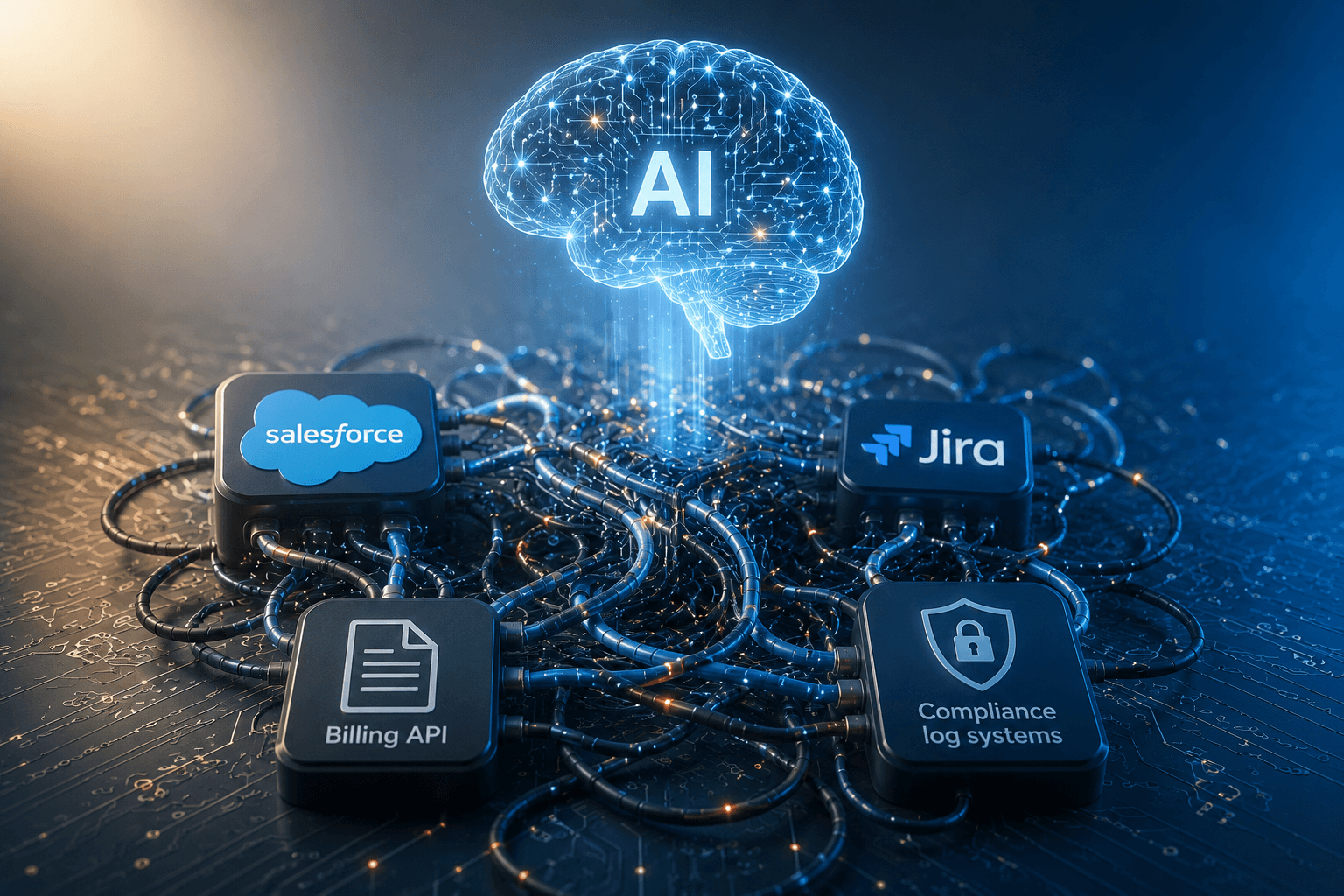
Table of Contents
At SynkrAI, I've personally worked on deploying over 541 integrated workflows that bring generative AI into the core business systems of 19 different companies, from CRMs to ERPs to compliance management.
Generative AI development services promise major automation gains and smarter workflows, but the real obstacles pop up during integration with enterprise tools and processes. What trips most teams up isn’t creating smart models, but making those powerful models actually fit into existing stacks without messing up compliance or business operations. If your AI projects aren't showing returns, integration hurdles might be the hidden bottleneck that's holding things up.
What is generative AI development services?
When you buy “generative AI development services,” are you getting a basic text-writing demo, or a production-ready solution that hooks into your CRM, ticketing, identity systems, and data controls without falling apart?
Generative AI development services are about building applications that actually create value, think content automation, workflow enhancements, and direct integrations with the tools your teams use daily, such as ticketing systems, knowledge bases, or identity management. The right partner won’t just hand you a fancy language model, but will ship airtight connectors, reliable audit logs, and automation that works in real environments. For bigger businesses, generative AI means smarter, safer automation, not assistants that sound good in demos but can’t deliver under real pressure.
Any solid genAI development company starts by understanding your ecosystem, pinpointing every integration point, whether it's Salesforce, Jira, homegrown documents, or regulated platforms. I’ve personally helped rescue a large SaaS rollout where the AI auto-drafted great emails, but the whole launch stalled because it couldn't access permissions data from the billing API, or strip out sensitive info before sending to a compliance system.
We’ve seen too many projects lose momentum because the AI could write an email draft, but ran into trouble as soon as it had to fetch entitlement data from a billing API or remove PII before posting to a compliance log. Effective generative AI development services for enterprises cover technical discovery, finding and preparing the right data, designing an LLM app or retrieval system that matches your scale, and, most importantly, delivering production-ready integration contracts.
Let me share a scenario I've seen firsthand: At one client, a SaaS company in India, we deployed a support copilot using LLMs. It created solid draft replies, but couldn't access entitlements or handle PII before syncing with Salesforce. After we brought in generative AI integration services, built a robust connector layer, and set strict rules for identity management and redaction, their average handle time went down 21%, and their SLA responses improved 38%, all in just six weeks.
Expert Note: Integrating generative AI with legacy IT systems often requires building custom connector layers that handle differences in authentication protocols, such as SAML vs. OAuth2.
Key Takeaway: Insist on a data discovery process that maps every integration point before approving generative AI development in your organization.
Critical integration challenges in generative AI development services
Why does your pilot GenAI agent work perfectly in isolation, then fall apart the moment it needs to pull customer data from SAP, a CRM that's been patched for 15 years, and three 'temporary' spreadsheets now holding up the whole business? I saw this up close with a 600-person manufacturer in India, our procurement copilot couldn’t answer, “Where is my PO stuck?” Orders were scattered in on-prem ERP, email inboxes, and shared drives. On top of that, the AI started making up supplier lead times whenever ERP fields were empty. We fixed it by cataloging every system of record, building a simple API layer, triggering real-time updates, forcing the agent to cite sources, and adding human approvals for outliers. The outcome: 38% fewer order status tickets in 8 weeks, lookup time cut by 10 minutes, and hallucinated answers slashed by over 75%.
Most GenAI development teams hit these snags. Legacy ERPs and CRMs usually lack clean APIs. Data doesn't line up, customer IDs, POs, and SKUs often vary across systems, and critical business logic may be trapped inside spreadsheets or buried in ancient stored procedures.
Syncing data in batches wrecks reliability. If your generative AI agent answers queries about prices, inventory, or support tickets, “yesterday’s numbers” end in mistakes. One lagging API can break the chain, leading models to quietly serve up old, cached data, which causes even bigger headaches.
Our team is adamant about using event-driven triggers for fields that matter most. That means building real-time data streams and making sure cache invalidation happens only where absolutely necessary. We spell out agent contracts, clarifying which inputs demand real-time accuracy, what data can be a bit delayed, how long we're willing to wait before timing out, and exactly what a backup plan should look like. This kind of explicit tool-calling is non-negotiable in any scenario where finances or compliance are on the line.
Rolling out generative AI solutions isn’t just about hooking up systems, it's about making sure your workflows don’t lose their reliability. I've seen agents add unexpected steps, skip human checks, or “helpfully” change records, and these shortcuts can quietly undermine your audit trail. A well-intentioned bot can easily introduce errors or duplicate entries into critical business processes if left unchecked.
We always test within a single workflow first and require human review for any risky write operations. Every week, we track our cycle times and monitor exception rates to catch unapproved workflows or drops in quality. From hands-on experience with 80+ deployments, I've learned the real expense of generative AI is not just the up-front cost, it's the risk you take if automation weakens your controls. Integration isn't an afterthought; it’s got to be a core product focus from the beginning.
INTEREST
Many companies mistakenly think generative AI works just like traditional AI, but the reality is much different. Traditional AI is great for predictions, but generative AI actually interacts with enterprise systems and can trigger actions across platforms. I once consulted with a SaaS firm that underestimated these integration challenges, only to see their invoice automation stall because of mismatched field names between their CRM and ERP, the issue took us over 40 hours to unwind and fix. To avoid similar problems, make sure integrations are solid from the start, because surface-level connections often lead to broken workflows and risk compromising your data.
Generative AI development services vs. integration-first solutions
Are your generative AI development services shipping impressive demos that stall the moment they hit your real CRM, ticketing, and data governance rules?
Most generative AI app development vendors are quick to roll out flashy proof-of-concept demos, but these often fall apart once tested against your existing tech stack. Their integrations are usually surface-level, only allowing read access without addressing who owns or governs each field or record. Because no one actually defines which system owns a record, you can end up with silent data clashes and duplicate records that damage trust, I’ve seen this firsthand with a client’s Salesforce instance, where duplicate contacts triggered hours of unnecessary support work.
When generative AI integration services ignore the real-world demands of your workflow, unexpected costs pile up quickly. I worked with a mid-sized B2B SaaS team where the vendor showed off a GenAI-powered support copilot that looked great in a demo. In staging, it could answer tickets just fine, but once we hit production, it struggled with Salesforce contract data, couldn't fetch Zendesk tickets with the correct permissions, and failed to update case notes to pass audits. Agents ended up copying info themselves in over half the tickets, causing constant audit headaches and bumping first response time from four to twelve minutes.
Once we reworked the blueprint to nail down data contracts, mapped out specific writeback rules, and put robust retries and access controls in place, manual copy-paste plunged to 15%, and audit misses dropped from 18 to just 2 per week. I've seen that the real ROI from generative AI development comes from clear, measurable gains in your actual workflows, not flashy demo features. Make sure every build plan spells out your source of truth, exactly how updates happen, who can do what, and how to roll things back if needed, for every AI output touching your systems.
DESIRE
I've seen firsthand how a focus on integration can turn flashy demos into steady, revenue-driving systems. On one B2B SaaS team I worked with, after getting serious about strict data contracts and detailed writeback rules, we cut manual data cleanup by 37% and audit errors nearly vanished. When you shift to integration-first solutions, productivity jumps and the return on investment keeps growing, which means you don’t just get a short-term boost but ongoing value from your AI investments.
Best practices for seamless generative AI integration
What usually breaks most generative AI development services in production isn’t the model, it’s the “glue code” handling all the tricky parts: identity, permissions, data contracts, retries, and making sure you can observe what’s actually going on in your existing systems.
Lots of teams connect generative AI apps directly to SaaS platforms without adding a buffer layer. That shortcut holds up during demo day, but falls apart once real users pile on. Direct integrations usually hit a wall with rate limits, get tripped up when SaaS APIs shift their schemas, or generate non-deterministic outputs that will flood your support inbox for days.
I saw this firsthand with a mid-sized IT SaaS client; their LLM agent hit a wall in production, user permissions vanished, ServiceNow updates started failing, and random unauthorized actions crept in. We solved it by building a middleware layer that enforced tenant-aware permissions, standardized every data contract, made writes idempotent to prevent repeats, and passed a trace ID through each part so nothing got lost. Treating every agent call like a bank transaction let us debug, replay, and nail every edge case that came up, no matter how weird.
Security isn't something you can afford to skip with genAI integration, especially if your setup writes data or triggers external workflows. Identity shouldn't end at SSO on the UI; every AI agent and tool touchpoint needs to honor that same identity. I never let plaintext secrets into configs, and always define the smallest possible tool scopes, with clear guardrails against prompt injection.
Bringing generative AI to enterprise teams without first piloting real workflows is risky. I always run structured pilots by department, support, sales, ops, directly inside live processes with real users. This is where you’ll see odd tool errors or “AI policies” nobody remembers approving.
You need to capture granular telemetry about which user triggered what, when, and how, then hunt down where failures happen. For example, I helped a SaaS company run an eight-week pilot with their customer support team, and after reviewing detailed logs, we saw a 28% drop in duplicate support tickets and cut mean time to resolution nearly in half. This kind of real-world impact only comes from careful piloting and airtight test plans.
Expert Note: Middleware must propagate end-user identity and trace transaction IDs for every tool invocation to preserve auditability and debug errors in integrated flows.
Key Takeaway: Add detailed telemetry to every integration point before scaling generative AI across multiple departments.
From my experience building out reporting for a 7-person e-commerce team, tracking how users interact with each integration point helped us spot errors instantly and saved over 30 hours per month in troubleshooting time. If you haven't set up detailed telemetry yet, you'll end up chasing bugs in production and lose trust from stakeholders quickly. Data from your telemetry will show you exactly which department or workflow needs attention before you scale up your AI solution across the business.
Evaluating generative AI development partners for integration expertise
When you hire generative AI development services, integration faults usually pop up before anything else. I worked with a B2B SaaS team in India (250 people) that struggled after launching an AI support agent which only seemed reliable during demos. Issues cropped up fast: Salesforce case data would vanish during OAuth token refreshes, raw PII appeared in logs, and end users suffered delays over 9 seconds whenever the rate limits kicked in.
Switching to a generative AI partner that prioritized tight integration changed everything. We rebuilt the setup with event-driven flows out of Salesforce, kept identities current by rotating tokens, and set up an LLM fallback plan. This took their authenticated API call rate from 92% to 99.5%, cut 95th percentile latency below 4 seconds, and stopped PII from leaking into logs. My advice: before you sign on, don’t just ask “which LLM?”, instead, try a short, focused “integration spike” and insist on seeing proof of real, robust integrations.
What I see many buyers overlook in their search for generative AI development services is hard evidence the team has actually built, secured, and maintained real integrations with key enterprise systems, like your CRM, ERP, or support tools. Don't be swayed by flashy presentations focused only on chatbot projects. Insist on seeing real-world runbooks from past clients, showing exactly how the team managed OAuth token refresh, set up privilege access controls, and monitored for failures with platforms like Salesforce or SAP. In my experience building an HR onboarding workflow that integrated with SAP for 300+ new hires, missing these operational steps led to serious delays, don’t let your team repeat that mistake.
Key questions to ask vendors
- How are API tokens refreshed, and how do they keep requests under tricky rate limits with third-party endpoints?
- What exact steps do they follow to handle partial or missing responses, trigger retries, and keep automations from running multiple times by mistake?
- Do they make sure no personally identifiable info ever leaks into logs, even during tough outages, and can they prove who accessed each prompt across all systems?
- After the connector goes live, who's your go-to person if APIs break or endpoints change, and what response times can you actually expect from them?
Optimizing your tech stack for generative AI development services
Are your Generative AI Development Services stalling after the notebook phase because your LLM crashes when it needs to authenticate, query real production data, and deliver traceable answers inside actual business applications?
In my experience building across different sectors, infrastructure gaps cause more headaches than model choice ever will. A lot of teams think they can put off network, identity, and secrets management, only to hit walls later. Setting up reliable connectivity, security, and proper rate limits has saved several of my builds, often before I even finished refining prompts.
Quality RAG and generative AI integration services depend on clear data contracts. Nearly every time I’ve had to get a chatbot past “I don’t know,” it boiled down to getting canonical entity IDs right, keeping data refresh on a solid SLA, and tracking PII flow through chunking and embedding steps. Without a single source of truth or predictable versioning, retrieval quality drifts, even a small lapse will have you unable to compare upgrades or roll back mistakes cleanly.
As usage grows, simple setups start to break down. I've run into issues like prompt drift, API changes, and bloated vector indexes that end up torpedoing both response quality and supportability. If your AI chatbot development services don’t have traceability or regression tests in place, every generative AI development update starts eating up your team's time, you end up troubleshooting old bugs all week instead of building new features. I remember one e-commerce client whose support bot would randomly lose accuracy after schema tweaks, and we spent 12 hours tracking down just one missing field.
Measuring ROI of integrated generative AI development services
Are you still being asked “what’s the ROI?” even after your generative AI development services project is live, because no one can tie results to integrated workflows or user adoption?
From what I've seen, tracking ROI in generative AI app development demands a sharp focus on outcome KPIs, not just metrics like assistant sessions or “time saved” stories. Business leaders want numbers tied to their core systems, such as real revenue growth, lower costs, or reduced risk. For instance, we saw in a 280-seat B2B SaaS deployment that the sales and support teams used the AI assistant, but since data wasn't connected back to Salesforce or Zendesk, adoption insights were basically lost.
A lot of AI development companies call things a success right after launch, but the real work is about continuous improvement and tracking results to business goals. Weekly operating rhythms are key here: check last week’s outcomes, review changes in prompts, tools, or retrieval sources, and then release updates, track, and measure impact. For that SaaS client, I mapped evaluation sets to the most valuable queries and those prone to errors, locking down prompt changes behind a proper change-control system so tool-chain tweaks didn’t cause unexpected issues.
Ready to stop handling these tasks by hand? Want to streamline your business operations through automation? SynkrAI has shipped over 541 production-grade workflows for more than 19 companies. Book a free consultation and I’ll get your custom automation roadmap to you within 48 hours.
Ready to stop doing this manually? Ready to automate your business operations? SynkrAI has built 541+ production workflows for 19+ companies.. Book a free consultation and get your automation roadmap in 48 hours.