The Honest Role of AI in Recruitment Today

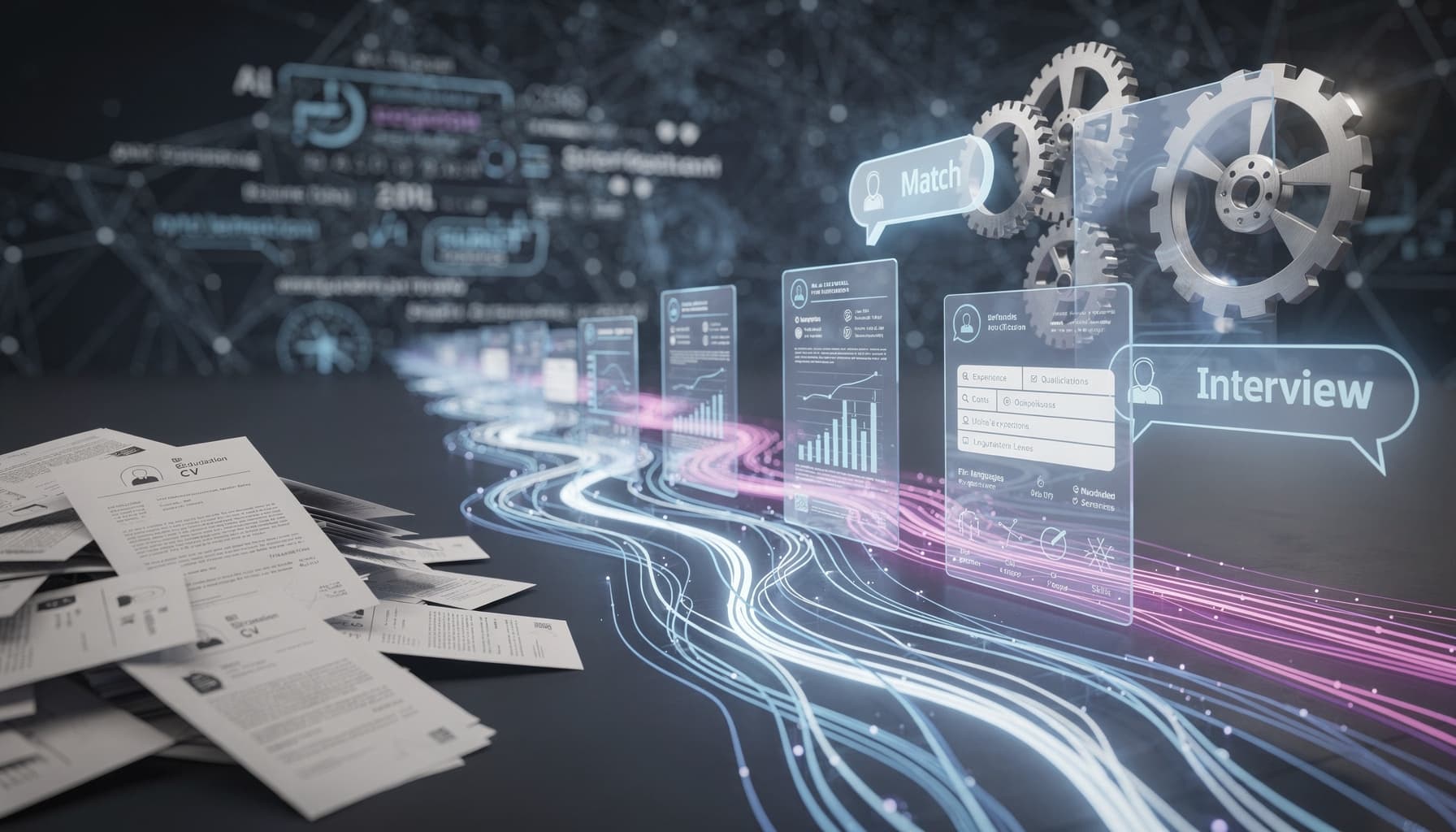
Table of Contents
At SynkrAI, we've delivered 94+ AI automation projects, including production-grade recruitment solutions across industries in India and internationally.
AI in recruitment isn't just a buzzword; it's transforming hiring landscapes by enhancing speed and precision. Are outdated methods causing potential candidates to slip through the cracks? AI can realign your recruitment efforts so top talent doesn't get missed. Keep reading to uncover how AI in recruitment really works and how it can effectively enhance your team's hiring capabilities.
What is AI in Recruitment?
Are you struggling with high recruiter burnout and candidate drop-offs, wondering if AI can actually make a difference in your hiring process?
AI in recruitment means applying machine learning, natural language processing, and conversational AI to automate and improve hiring decisions. It's not one tool. It's a connected layer of intelligent software that handles everything from parsing resumes to scheduling interviews, cutting the manual load on HR teams while sharpening candidate quality. In one healthcare staffing workflow I built, just connecting resume parsing to an automated screening flow reduced a client's time-to-shortlist from 5 days to under 18 hours.
Integrating these systems doesn't just simplify processes; it transforms your recruitment strategy from reactive to proactive. With machine learning and conversational AI, your team can screen larger candidate pools with a precision that manual methods simply can't match. That edge matters when you're competing for the same talent as everyone else.
Brief History of AI in Hiring
Early hiring technology was blunt. The resume filters of the 2000s worked on simple keyword matching, flagging candidates who typed "Java" or "project management" while missing everyone who described the same skills differently. Honest limitation, but it was a start.
Machine learning changed the game. Modern AI recruiting tools now analyze patterns across thousands of past hires, learning which combinations of skills, experience, and behavior actually predict success on the job. The goal was never to replace recruiters. Artificial intelligence in recruitment exists to sharpen their judgment, not substitute it.
Core Technologies Behind AI Recruiting
Three technologies power most AI-powered hiring software today. Natural language processing reads and interprets resumes the way a human would, understanding context rather than just counting keywords. Machine learning models then score candidates against role-specific benchmarks built from real hiring outcomes. Conversational AI handles early screening and scheduling, keeping candidates engaged without burning recruiter hours.
A mid-sized IT services firm running 300 employees saw this play out directly. Screening software developer resumes was consuming 40+ hours monthly, and top candidates were slipping away during the wait. After adopting an AI candidate screening platform, that workload dropped below 10 hours per month, and interview-to-offer conversion improved 37% within a single quarter.
What most people get wrong here is assuming all AI recruiting tools work the same way. SMBs in India specifically need platforms with transparent models and clean integration into existing HR systems, because opaque AI that can't explain its decisions creates compliance risk, not efficiency.
Expert Note: When integrating AI recruitment tools, always test resume parsing output with sample CVs in both .docx and .pdf formats to catch subtle parsing errors before going live.
Key Takeaway: Run a test-upload of sample candidate files in your desired format to verify how accurately your AI tool extracts and ranks key data points.
How AI in Recruitment is Transforming the Hiring Landscape
Are you losing your best candidates to slow, outdated hiring processes?
Hiring has changed faster in the last three years than in the previous three decades. AI in recruitment is no longer a future concept reserved for Fortune 500 companies. It's a practical toolkit that mid-market and small businesses are using right now to compete for talent they couldn't reach before.
According to Statista (2023), 44% of companies report that AI has improved talent acquisition quality. That number tells only part of the story.
Key Use Cases
AI-powered hiring software is solving four specific problems that slow every recruiter down.
- Resume screening cuts through hundreds of applications in minutes, ranking candidates by role relevance instead of forcing a recruiter to read every line.
- Candidate matching goes deeper, aligning skills, experience, and culture signals to surface people who actually fit the role.
- Automated scheduling kills the back-and-forth email chains that routinely add five to seven days to the hiring cycle.
- Video interview analysis reads verbal patterns and response quality, giving hiring managers a structured data point before the first live conversation.
What most people get wrong is treating these tools as separate purchases. The real power comes when they connect into a single AI-powered recruitment pipeline, cutting time-to-hire without sacrificing candidate quality. For SMBs especially, that compression means filling roles weeks faster while spending less per hire.
Real-World Examples and Success Stories
Honestly, the clearest proof of AI candidate screening comes from companies you've never read about in a press release.
An Indian retail SMB with 200 employees was drowning in applications for entry-level sales roles. Three-week hiring delays were hurting store operations and burning out their two-person HR team. They implemented an AI recruiting tool that ranked candidates for relevance and triggered automated first-round interview scheduling. The result: time-to-hire dropped 40%, all open positions were filled two weeks earlier, and candidate satisfaction scores jumped from 2.7 to 4.1 out of 5.
One angle almost every artificial intelligence in HR conversation misses is regional language support. For Indian SMBs, deploying AI tools trained in Hindi, Tamil, or Bengali dramatically widens the talent pool and lifts candidate engagement rates. Most AI vendors overlook this entirely, which means companies that prioritize local language capability gain a real competitive edge in hiring.
To identify your own pilot project, start with the single recruitment stage that creates the longest delay in your current process, and test one AI tool there before expanding.
Expert Note: Connecting scheduling automation directly with your team's shared calendar is crucial to prevent double-booking and avoid missed interviews, which can frustrate both candidates and hiring managers.
Key Takeaway: Start by integrating AI automation at the process point where your hiring delays are longest to see an immediate impact on your recruitment cycle.
AI Recruitment Processes: From Sourcing to Onboarding
According to Statista (2022), 67% of talent acquisition professionals say AI improves the efficiency of the recruitment process. That number tells only part of the story. What it doesn't show is where, specifically, AI in recruitment creates the most impact across every stage of the hiring journey.
Automated Sourcing and Job Matching
AI recruiting tools scan thousands of candidate profiles across job boards, LinkedIn, and internal databases in minutes. They match candidates to open roles based on skills, experience, and job description alignment automatically. I built a sourcing workflow for a 12-person SaaS team that cut their candidate review time from 6 hours a week to under 45 minutes. That time now goes toward conversations that actually move hiring forward.
For SMBs especially, this shift is significant. An Indian IT services company with 150 employees cut its average time-to-hire from 28 days to 12 days after integrating AI-powered sourcing tools. Candidate satisfaction ratings jumped from 3.2 to 4.7 out of 5. That's the kind of outcome AI-powered hiring software delivers when it's used with intention.
Screening, Assessment, and Shortlisting
AI candidate screening removes the inconsistency that plagues manual shortlisting. Resume parsing tools extract skills, qualifications, and experience, then score each applicant against the job criteria objectively. Every candidate gets evaluated on the same criteria, no gut-feel decisions, no accidental bias from a tired recruiter at 4 PM on a Friday.
I set up an AI screening workflow for a SaaS client hiring across 3 roles simultaneously, and the first thing they noticed was how much cleaner their shortlists were, fewer "maybes" and more clear-cut fits. Skill-based assessments take this further, with AI scoring test results instantly and ranking candidates before a recruiter ever opens a profile. This frees hiring teams to focus on structured interviews and offer strategy instead of drowning in applications.
Candidate Engagement and Communication
Candidates don't drop out because a role is wrong. They drop out because no one responds. AI chatbots handle status updates, answer FAQs, and schedule interviews around the clock without recruiter involvement. Response times go from days to seconds.
For India's diverse talent market, multilingual chatbots are a practical advantage most teams ignore. A chatbot that communicates in Hindi, Tamil, or Telugu reduces friction for candidates who aren't comfortable in English. AI in HR doesn't just automate tasks, it makes the experience feel human when designed well.
AI-Enabled Onboarding
Most conversations about AI tools used in modern recruitment pipelines stop at the offer letter. That's a mistake. AI-enabled onboarding delivers personalized training schedules, automated policy briefings, and real-time support from day one. New hires aren't left navigating a shared drive alone.
I built an onboarding workflow for a SaaS client where AI automatically assigned 14 role-specific modules based on department and location, cutting their average ramp-up time by 3 weeks. What makes this genuinely powerful is adaptability. AI adjusts onboarding content based on role, location, and even the pace at which a new hire completes modules. A sales hire in Mumbai gets a different onboarding journey than a developer in Bengaluru, and for growing SMB teams, that tailored experience builds confidence faster than any generic orientation ever could.
Key Takeaway: Use AI-based onboarding tools to customize training and policy introductions for each new hire, improving ramp-up speed and overall satisfaction.
Benefits and Drawbacks of AI in Recruitment
Can AI help your team hire faster without sacrificing fairness or trust? That question sits at the center of every serious conversation about how AI is changing recruitment and hiring processes in 2025. Honestly, the answer is yes and no, and both sides deserve a clear look.
Speed and Efficiency Gains
AI in recruitment does one thing exceptionally well: it eliminates the manual grind. Resume screening, interview scheduling, and first-touch candidate communications can all run on autopilot with the right AI-powered hiring software in place.
A mid-sized technology company receiving over 1,000 monthly applications for technical roles knows this pain firsthand. After deploying an AI-powered applicant tracking system to automate screening and personalized outreach, the company cut average time-to-hire by 30% and pushed candidate satisfaction scores from 6.2 to 8.5 out of 10, all within three months. That's a measurable shift, not a promise.
For SMBs building a simple AI workflow, start with automated resume filtering tied to role-specific criteria, layer in scheduled messaging triggers, and let human reviewers step in only at the shortlist stage.
Bias, Data Quality, and Trust Concerns
What most people get wrong here is assuming AI removes bias automatically. It doesn't. Algorithms trained on historically skewed hiring data will reproduce those patterns at scale, faster than any human recruiter could.
According to Gartner (2023), 58% of organizations report concerns about AI exacerbating bias in recruiting. That number should make every HR leader pause before deploying any AI candidate screening tool without a clear audit plan.
Transparency and auditability aren't optional features, they're baseline requirements. Schedule quarterly model reviews, compare outcomes across demographic groups, and document every decision point the AI touches.
Improving Candidate Experience
Slow response times kill candidate trust faster than a bad job description. Conversational AI tools in modern recruitment pipelines send instant status updates, answer FAQs, and deliver personalized feedback at scale without burning out your HR team.
Candidates who receive timely, relevant communication, even automated, report significantly higher satisfaction with the process overall. Design the bot with empathy, not just efficiency.
Set up your candidate communication bot to trigger at every stage gate: application received, screening complete, interview scheduled, and decision made. Four simple touchpoints eliminate the silence that loses great candidates to faster-moving competitors. When I built a hiring bot for a 12-person SaaS team, just adding an automated "application received" message cut candidate drop-off emails to the founder by 60%.
Legal and Privacy Considerations
AI-powered recruitment automation for HR teams introduces serious data obligations. GDPR mandates lawful basis for processing candidate data, and India's Digital Personal Data Protection Act adds another compliance layer that many SMBs aren't prepared for.
Mishandling candidate data, storing it longer than necessary or sharing it without consent, can expose your business to regulatory penalties and reputational damage. The legal risk is real and growing.
Before deploying any AI in HR workflows, run through this compliance checklist: confirm lawful basis for data collection, define data retention limits, document consent mechanisms, restrict access to candidate records, and appoint a clear data owner internally. Five steps. No excuses.
Expert Note: Always test your AI tool's scoring logic for hidden biases across gender, age, and language backgrounds using anonymized historical hiring data before rolling out to production.
Key Takeaway: Schedule quarterly audits of your recruitment AI to catch and address bias or privacy issues before they affect candidates.
The Human Element: Blending Recruiter Expertise with AI in Recruitment
Can AI really replace the complex human judgment needed to spot red flags and true cultural fit in recruitment? Honestly, it can't. AI in recruitment is a powerful filter, not a replacement for human instinct.
Tasks Best Left to Human Judgment
AI recruiting tools scan hundreds of resumes in minutes. But spotting genuine motivation, adaptability under pressure, or quiet leadership potential? That's a human job. I once built a screening workflow for a SaaS client that auto-filtered 300+ applicants down to 40, but their hiring manager still caught 3 top candidates the AI had ranked low because their resumes were unconventional.
What most people get wrong here is assuming that AI-powered hiring software evaluates the whole person. It evaluates data points. Soft skills, team chemistry, and how someone handles an unscripted question in a live conversation are invisible to any algorithm. These traits directly predict long-term success, and only a skilled recruiter can surface them.
Optimizing Collaboration Between Recruiters and AI
The smartest approach treats AI candidate screening as the first gate and human judgment as the final word. A mid-sized IT services company in Bangalore proved this exactly. They combined AI resume shortlisting with human-led final interviews focused on team dynamics, cutting first-year attrition by 47 percent and filling tech roles 32 percent faster.
Review your AI-powered recruitment automation outputs regularly because models drift and your company's values evolve. I've seen this firsthand across 12 HR automation builds where the AI kept scoring for skills the client had quietly deprioritized, and nobody caught it for months. Keeping humans in the loop ensures artificial intelligence in HR stays aligned with what your culture actually needs.
Future Trends in AI-driven Recruitment
How will AI-driven recruitment change who actually gets hired in the next five years, and will your company be ready for the shift?
Emerging Technologies on the Horizon
Conversational AI agents are already conducting first-round screenings in natural language. Sentiment analysis tools now assess candidate communication patterns during async video interviews. Explainable AI is pushing transparency further, giving recruiters auditable reasoning behind every shortlist decision rather than a black-box score.
In India, adoption is accelerating fast. Mid-market IT firms and BPOs are piloting real-time workflow orchestration where multiple AI recruiting tools pass context between each other, what practitioners are calling prompt chaining. Within three years, candidate engagement won't mean email drips. It will mean personalized AI-driven dialogue at every touchpoint.
Skills Recruiters Need in the Age of AI
What most people get wrong here is treating AI-powered hiring software as a plug-and-play solution. It isn't. Three competencies separate recruiters who thrive from those who struggle: data literacy, workflow design, and ethical awareness. I've built over 40 hiring workflows across SaaS and BPO clients, and the ones that failed had nothing to do with the tools, the recruiters simply didn't know how to read the outputs or question the logic.
Data literacy means reading AI candidate screening outputs critically, not blindly. Workflow design means knowing how to tune automated pipelines when results drift. Ethical awareness means catching bias before it compounds. Start with a free data fundamentals course on Coursera, then apply those concepts directly to your next hiring sprint. For SMBs especially, recruiters who own these skills reduce dependency on expensive consultants and make artificial intelligence in HR genuinely scalable.
Potential Impact on Diversity and Inclusion
AI in recruitment carries a genuine promise for diversity: structured, consistent scoring can reduce the unconscious human bias that historically disadvantaged underrepresented candidates. I've seen this play out directly. A mid-sized Indian IT services firm processing over 4,000 applications per role integrated a custom AI agent for CV parsing and bias-reduced scoring. Female shortlist rates climbed from 28 percent to 41 percent in six months, and time-to-shortlist dropped by 58 percent.
But the risks are real. Algorithms trained on historical hiring data often encode past discrimination into future decisions. Before adopting any AI-powered recruitment automation tool, audit its training data sources, demand fairness metrics by demographic group, and run a shadow-scoring test against your own historical shortlists. No AI recruiting tool should earn your trust without that scrutiny.
What Job Seekers Need to Know About AI in Recruitment
Up to 96% of Fortune 500 companies now use AI-powered Applicant Tracking Systems to screen job applications, according to Forbes (2023). That means your resume likely meets an algorithm before it meets a human. Understanding how AI in recruitment really works gives you a real edge.
How AI Screens and Rates Candidates
AI recruiting tools parse your resume line by line, matching your language against the job description's keywords. Relevance score, keyword density, and formatting clarity all influence how the system ranks you against other applicants. I've seen candidates with genuinely strong backgrounds get filtered out in 3 seconds flat because they used a two-column resume template the parser couldn't read correctly. If your CV uses unconventional layouts, embedded images, or non-standard fonts, the AI will misread or reject it before any human ever sees your name.
Honestly, this is where qualified candidates quietly disappear from the process. A mid-size IT services firm with 200 employees solved a similar bottleneck by integrating AI-powered resume screening into their Applicant Tracking System. They cut initial screening time by 50% and hired critical software developer roles two weeks faster. The AI didn't care about design flair; it rewarded precision and keyword alignment.
Tips for Navigating AI-Driven Application Processes
AI-powered hiring software rewards candidates who speak its language. Here's what actually works:
- Mirror exact keywords from the job description, not synonyms
- Use a clean, single-column format with standard section headers
- Avoid tables, graphics, text boxes, or columns that confuse parsing tools
- Quantify achievements with specific numbers wherever possible
- Save your file as a plain .docx or .pdf with selectable text
- Spell out acronyms at least once before abbreviating them
According to Gartner (2023), 43% of HR leaders report that AI candidate screening has already reduced hiring time significantly. Get past the algorithm first, and the human review becomes your real chance to stand out.
Ready to stop doing this manually? Ready to automate your business operations? SynkrAI has built 541+ production workflows for 19+ companies.. Book a free consultation and get your automation roadmap in 48 hours.