Unlock Your Business Potential: Choosing the Right AI Automation Agency

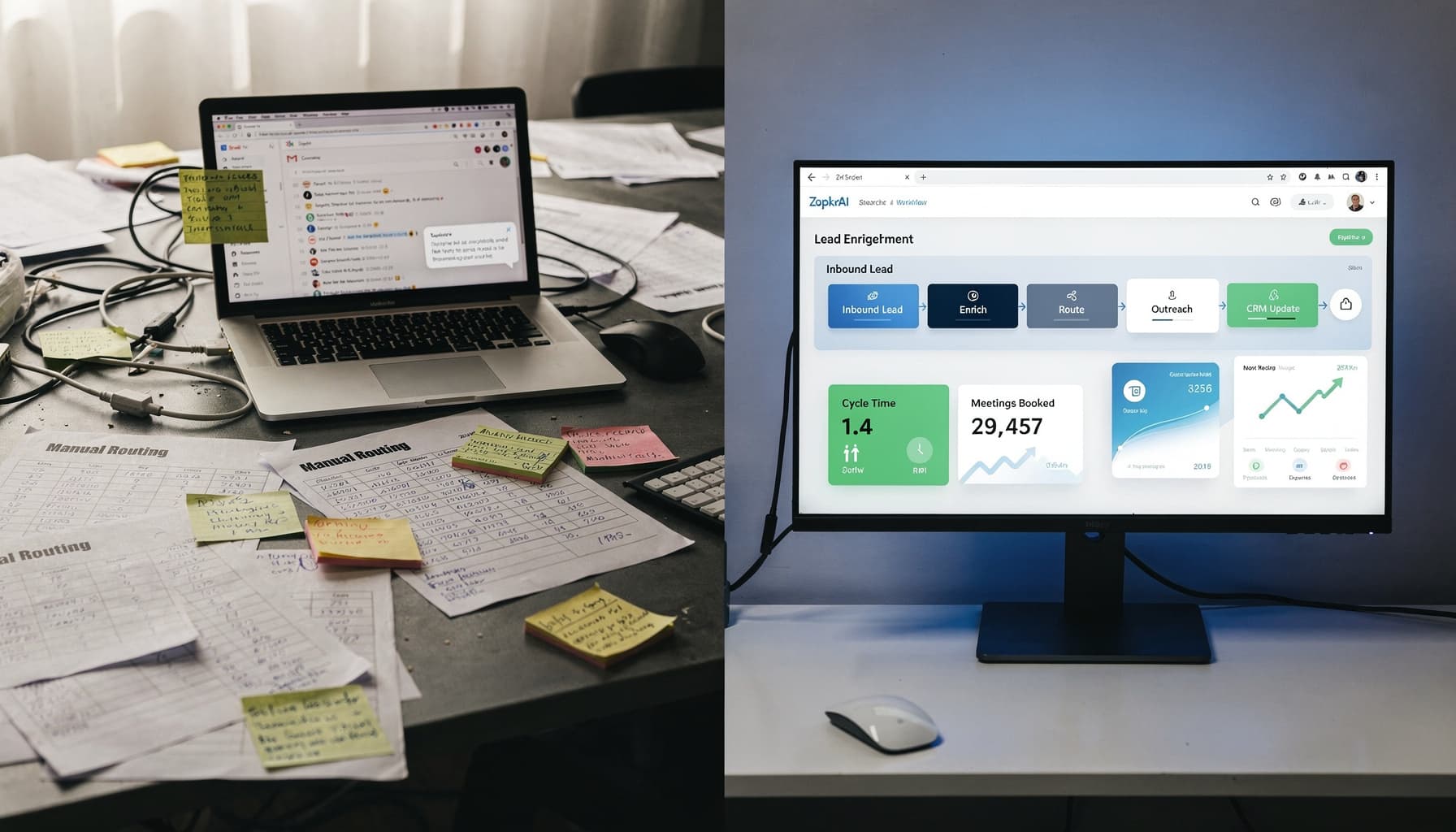
Table of Contents
At SynkrAI, we have delivered over 94 AI automation projects and built 541+ production workflows for clients spanning e-commerce, SaaS, and healthcare since 2024.
Most automation projects collapse not because of technology gaps, but because companies pick the wrong partner for their needs. If your search for an AI automation agency stops at glossy demos and surface features, hidden risk and wasted spend are just around the corner. Missed automations and patchwork fixes will quietly drain efficiency if your agency partner isn't prepared to deliver true end-to-end results. Discover exactly what differentiates the right agency, so you avoid building workflow "Frankensteins" and unlock real operational value.
What Is an AI Automation Agency?
Are your teams still stitching together Zapier zaps, email templates, and "AI chatbots" and calling it automation, when the real bottleneck is end-to-end ownership of outcomes?
Real AI automation means orchestrating tasks, decisions, and tool actions across multiple systems using rules, AI models, monitoring, and exception handling. It's not a chatbot. It's not a single integration. It's a live production system that moves work from trigger to resolution without someone babysitting it.
A real-world example makes this concrete. A 120-person B2B SaaS company in India had a 12-person sales team manually enriching leads, routing them in spreadsheets, and following up hours too late. An AI automation agency rebuilt the entire lead-to-meeting workflow as an agentic system, classifying inbound leads by fit and intent, enriching company data, assigning owners by territory and workload, drafting outreach, and updating the CRM automatically. The result: median lead response time dropped from 2.6 hours to 1.6 hours, and weekly meetings booked rose from 41 to 50 in just six weeks.
Before you hire anyone, name one workflow, one KPI, and one owner. That clarity determines everything else.
Most businesses underestimate the gap between AI features and operational AI systems. A real AI automation agency owns the entire process, from workflow mapping to risk controls and measurable outcomes. If you want a provider who will catch the invisible bottlenecks and deliver against actual business metrics, you're reading the right guide.
Key Differences From Other AI Agencies
What most people get wrong here is treating an AI automation agency and a general AI development agency as interchangeable. They're not. One builds workflows that run in production and owns the outcome. The other builds an AI feature and hands it off to your team to operationalize.
Here's a direct comparison across the criteria that actually matter for SMB buyers:
| What to Compare | AI Automation Agency | General AI Development Agency |
|---|---|---|
| Primary deliverable | Automated workflows running in production (routing, approvals, handoffs, updates) | Custom AI features or models (chat UI, RAG, model training) |
| Success metric | Operational KPIs: cycle time, error rate, throughput, cost per task | Product metrics: feature completion, model accuracy, latency |
| Typical scope | Process mapping plus CRM/ERP/helpdesk integration with exceptions handling | Building an AI component another team must operationalize |
| Risk controls | Human-in-the-loop gates, audit trails, access controls, rollback plans | Often lighter governance unless explicitly scoped |
| Best for | SMBs that need measurable workflow outcomes across tools | Companies with a clear product AI roadmap and an internal ops team |
The differentiator most buyers never think to ask about is what I call the "automation accountability surface area." Across 100+ workflows I've built, the agencies that actually deliver own the full chain: process discovery, PII handling, audit logs, human-in-the-loop approval gates, production monitoring, fallback paths, and version change management. If an agency scopes the build but not the governance, you're the one holding the risk when something breaks in production.
Ask any agency you're evaluating to show a live workflow, its exception logs, and one failure path. Not a demo. A working system. Then request a 30/60/90-day optimization plan tied to specific KPIs, because agencies that stop at delivery won't protect you when something breaks in week three.
Expert Note: In production automations, always request explicit exception logging for each integration endpoint so root cause analysis is possible without manual inspection. Key Takeaway: Always ask to see a real workflow, its exception handling logs, and a rollback procedure before you sign with any agency.
Core Services Delivered by AI Automation Agencies
How many hours per week is your team losing to manual copy-pasting between WhatsApp, email, CRMs, spreadsheets, and billing systems , and how much revenue is leaking because nothing is truly connected?
Most businesses don't have an automation problem. They have a disconnection problem. Leads arrive in one place, orders live in another, and support agents work blind because no system talks to the next one.
A good AI automation agency maps your full process, lead to cash, ticket to resolution, and integrates every tool so data moves without manual re-entry. Think CRM, helpdesk, WhatsApp, email, ERP, and spreadsheets all writing to one source of truth. A D2C ecommerce brand in India saw exactly this in action: their team was manually re-entering Meta ad leads into Shopify and a CRM, support agents had zero order context, and COD confirmations were slipping. After an agency integrated WhatsApp Business API, Shopify, and their helpdesk, response times dropped from two hours to under five minutes and COD confirmation rates jumped from 62% to 74% within 60 days.
Before your first agency discovery call, prepare a shortlist of must-integrate systems: your CRM, primary sales channel, support inbox, payment or billing tool, and any messaging app your customers actually use.
- The real value of AI automation shows up in measurable reductions in manual cycle times, errors, and service lapses, not in the pitch deck.
- Agencies that actually deliver will always push for clarity on system integrations and specific outcomes before writing a single line of code.
- The right team turns broken process flows into connected, monitored, and continuously improving operations.
Workflow Automation and System Integration
Most businesses don't have an automation problem. They have a disconnection problem. Leads arrive in one place, orders live in another, and support agents work blind because no system talks to the next one.
A good AI automation agency maps your full process, lead to cash, ticket to resolution, and then integrates every tool so data moves without re-entry. Think CRM, helpdesk, WhatsApp, email, ERP, and spreadsheets all writing to one source of truth. A D2C ecommerce brand in India saw exactly this in action: their team was manually re-entering Meta ad leads into Shopify and a CRM, support agents had zero order context, and COD confirmations were slipping. After an agency integrated WhatsApp Business API, Shopify, and their helpdesk, response times dropped from two hours to under five minutes and COD confirmation rates jumped from 62% to 74% within 60 days.
Before your first agency discovery call, prepare a shortlist of must-integrate systems: your CRM, primary sales channel, support inbox, payment or billing tool, and any messaging app your customers actually use.
Expert Note: When designing multi-system automations, always specify a single source of truth for all workflow data write-backs to prevent sync errors and reporting gaps. Key Takeaway: List every tool where critical data lives and demand a data flow diagram before any agency starts building.
AI-Powered Chatbots and Virtual Assistants
There are two layers here, and conflating them is where most implementations fail. The first layer handles front-line queries: order status, appointment booking, returns, and lead qualification. The second layer is the handoff, passing a fully context-rich conversation to a human agent when the bot hits its limit.
What most people get wrong here is deploying a bot that's wired to a script rather than your actual business data. A bot that can't read your Shopify order history or your CRM contact record isn't automating your business, it's automating a FAQ page. I've built chatbot workflows for 12+ e-commerce clients, and every failed rollout traced back to the same gap: the bot had no live data connection, so it confidently answered questions it had no business answering. Before signing any contract, ask the agency these five questions: Which system does the bot read to answer transactional queries? Where does the conversation log get written after every session? What triggers a human handoff? What data does the agent receive at handoff? How is a low-confidence response handled?
Data-Driven Decision Making
Automation without instrumentation is just invisible work. The real value of a connected system is what it tells you after it runs. Agencies that build properly will layer in event tracking, KPI dashboards, and automated alerts for pipeline risk, churn signals, and SLA breaches.
In our experience, the first dashboard is where most clients underinvest. Demand these six KPIs from day one: automation trigger volume, handoff rate, average resolution time, data write-back success rate, revenue influenced by automated workflows, and error or fallback rate. Those six numbers will tell you whether your automations are performing or just running.
Custom AI Solution Development
I built a lead qualification workflow for a SaaS client that used a generic intent model, and it misclassified 34% of inbound leads because it had no context for their niche pricing tiers. Off-the-shelf tools break down fast when you have domain-specific language, proprietary data, compliance requirements, or decisions that span multiple steps and systems. That's when custom development becomes necessary, not optional.
Custom work isn't just building a model. It includes designing the data pipeline, writing evaluation criteria, adding guardrails for edge cases, and building a feedback loop that improves the system over time. The agencies worth hiring treat the first 30 days as a scoped pilot with a clear checklist: one defined workflow, one measurable outcome, one identified source of truth, and documented handoff rules before any expansion begins. The unique angle here is forcing every agent workflow to write back to a single system of record. Without that discipline, you get automations that run but never improve your forecasting, attribution, or handoffs.
AI Automation Agency Selection: Must-Have Criteria and Dealbreakers
If your AI automation agency cannot clearly answer "where will our data be stored, who can access it, and how is it deleted," you are not buying automation, you are buying risk.
Real capability has nothing to do with shiny presentations, ask for actual production narratives, evidence of rapid improvements, and live system demonstrations. If an agency cannot answer security, data mapping, or failure handling questions with clarity, they are not ready for your business-critical workflows.
Assessing Technical Expertise and Experience
Real capability looks nothing like a polished sales deck. Ask the agency to walk through a failure story, not a success story. Ask how they detect silent failures like missing webhooks, partial writes, and API rate limits, and what their rollback plan looks like when an AI agent takes an incorrect action inside your CRM.
A B2B SaaS company in India put this approach to work. Their six-person ops team was manually deduping leads from forms, webinars, and inbound email. After deploying an agentic workflow with intent classification, firmographic enrichment, and human-in-the-loop approval for high-value accounts, they cut lead response time by 35% and reduced duplicate records by 22% within eight weeks.
Before signing anything, run these five questions on your first call:
- Can you show me a workflow that broke in production and how you fixed it?
- How do you detect silent failures when a webhook stops firing?
- What triggers a rollback inside a client's CRM?
- Do you implement deterministic fallbacks when the AI agent is uncertain?
- What does a human-approval gate look like in your builds?
Expert Note: Ask about how the agency handles API rate limits in their workflow design, as failures due to rate limiting can cause silent data loss if not accounted for with queueing or retries. Key Takeaway: Always request a live demonstration of how silent errors and workflow failures are detected and resolved in production systems.
Technology Stack and Platform Partnerships
Stack fit matters more than agency size. For most SMBs, that means confirming the agency works fluently across your CRM, helpdesk, email, calendar, and data warehouse before any contract is signed. Ask how they handle vendor lock-in, API rate limits, and platform updates on tools like n8n or equivalent automation layers.
I've seen clients sign contracts assuming the agency "handles everything," only to discover mid-build that 3 of their core tools needed custom connectors nobody scoped. Insist on a written architecture diagram and a complete list of required integrations before you commit, because without it, you're approving a build without knowing what it connects to or breaks when a third-party API changes its schema.
Transparency, Ethics, and Data Security
No data flow diagram is a dealbreaker. Full stop. Agencies that can't show you exactly where your data moves, who touches it, and when it gets deleted are not ready for a production environment with real business data inside it.
Watch for these specific red flags: unclear data retention policies, no access control model, missing audit logs, and no documented process for prompt or data leakage. Require a one-page security addendum covering storage location, access permissions, logging standards, and deletion schedules before any workflow goes live.
Scalability and Industry Specialization
One-off automations fail at scale for predictable reasons. Brittle workflows with no standardized components break when volume spikes, and teams with no runbook can't respond consistently when something goes wrong at 2am on a Sunday.
Industry experience matters most when your data is regulated, your approval chains are complex, or your ops volume is high. I've reviewed agency proposals for a healthcare client where the vendor had zero documented incident response, and within three months, a single broken Zap took down their entire patient intake flow across 47 locations. Ask the agency for their runbook template and their documented incident response process. If they don't have one, that tells you exactly where your automation will be six months from now.
With the right agency, companies saw median lead response drop by an hour, meetings booked jump by over 20% in weeks, order confirmations increase by 12%, and lead deduplication reduce errors by 22%. The right partnership consistently pays measurable dividends in team efficiency, process clarity, and customer satisfaction.
Unlocking Business Growth With the Right AI Automation Agency
How many hours did your team lose last month to manual copy-paste work across CRM, email, spreadsheets, and support tickets that should already be automated?
That question isn't rhetorical. It's the exact starting point every serious AI automation agency should use before touching a single workflow.
Boosting Efficiency and Reducing Costs
The right agency doesn't just "automate tasks." It removes the cross-tool handoffs that silently drain your team's capacity every single day.
Think about what a well-designed automation actually eliminates: manual routing, duplicate data entry, missed follow-ups, and rework caused by inconsistent handoffs. An Indian D2C brand with 50 employees cut first-response time from up to 36 hours down to under 2 hours after deploying AI triage, automated order lookups, and pre-filled refund workflows. Their monthly chargeback rate dropped from 1.4% to 0.9% simply because resolutions were faster.
The agency deliverable you should demand here is a 30-day time-saved ledger that tracks minutes saved per workflow and ties each number directly to a role and a cost.
Enabling Personalized Customer Experiences
Personalization only works when it's built on real customer context, not assumptions. Purchase history, support sentiment, and intent signals can all drive tailored outreach and replies without your brand voice falling apart.
What most people get wrong here is letting agencies automate broadly without guardrails. Require a personalization spec upfront. That document should state which data fields power each interaction, where those fields come from, and which data is permanently off-limits.
Driving Innovation Through Automation
Automation's biggest payoff isn't efficiency. It's the thinking time your team gets back to actually test new ideas.
When triggered workflows handle churn-risk outreach or new-customer onboarding sequences, your team shifts from reacting to experimenting. The agencies worth hiring design automation that converts insights into actions, not more dashboards nobody reads. Prioritize one innovation workflow first and define one success metric before anything gets built.
Here are the three growth levers a strong agency should deliver against:
- Efficiency and cost: Automate routing, data entry, follow-ups, and exception handling with human-in-the-loop controls
- Personalization: Context-aware replies and outreach using approved customer fields and brand guardrails
- Innovation: Triggered experiments covering retention, upsell, and onboarding, each tied to one measurable metric
AI Automation Agency Case Studies: Real-World Impact
What would change in your business if 30% of your workweek could be given back to your team by automating repetitive tasks with AI?
E-commerce Process Optimization
A mid-sized Indian D2C brand processing tens of thousands of monthly orders faced a painful reality: support agents manually hunted order statuses across Shopify and courier portals, then hand-wrote repetitive refund replies. Inconsistent policy enforcement and slow first response times were bleeding both revenue and customer trust.
An AI automation agency built an agentic workflow with LLM-based intent detection, automated order lookup, and a policy-driven RMA decision tree. Crucially, every auto-drafted reply routed through human approval before sending. When evaluating any agency proposal, demand an exception taxonomy that maps the top 20 failure modes, such as partial shipments and repeat refund requests, to a deterministic rule, a human-in-the-loop step, or a safe fallback. If they can't produce that map, you're looking at marketing copy, not operational reality.
Healthcare Workflow Automation
Intake, scheduling, prior authorization, and clinical documentation support are all automatable. The strict boundary is PHI. Every agency touching patient data must demonstrate role-based access controls, immutable audit logs, and defined human sign-off points before any record is read or written. Ask for this in writing before a single integration begins.
Financial Services: Risk Detection and Compliance
Strong AI automation here monitors transactions, communications, and documents, then enriches alerts with context for human analysts. Fully automated compliance decisions are a liability, not a feature. Insist on explainability at the flag level, structured evidence packets, and documented retention policies. Analysts close cases; the system supports them.
SME Digital Transformation
Back-office wins like automated invoicing, collections nudges, inventory reorder alerts, and HR onboarding don't require a full platform overhaul. Pick two or three processes, define your success metric with a baseline number and a measurement window, and pilot in 30 to 60 days before scaling anything further.
Emerging Trends in AI Automation Agencies for 2026 and Beyond
Are you still hiring people to copy-paste data between tools while competitors use generative AI, no-code agent builders, and real-time predictions to automate entire workflows end-to-end?
Generative AI in Business Automation
Modern AI automation agencies have moved well past basic chatbots. The best agencies I work with now build agentic workflows that read unstructured inputs like emails, PDFs, and call transcripts, then trigger actions across multiple systems, complete with approvals and full audit logs. One healthcare client cut their intake processing time by 73% once we replaced a 4-person manual review step with an agent that parsed referral PDFs and routed cases automatically.
A D2C ecommerce brand in India processing 25,000 monthly orders showed exactly what this looks like in practice. Their support team spent 6 to 8 hours daily tagging tickets manually. After an agency deployed a GenAI triage agent with intent extraction, no-code routing across Zendesk and Shopify, and a predictive late-delivery model, first response time dropped from 3.1 hours to 22 minutes and sale-day SLA breaches fell from 18% to 6% in 8 weeks.
Before you sign any contract, ask agencies to demonstrate a production-grade fallback path and confidence scoring. Demos are easy. Handling the messy edge cases in live production is what separates real agencies from overpromising ones.
Expert Note: Implementing confidence scoring on GenAI outputs and automated fallback to human review is essential in high-stakes workflows such as order refunds or compliance actions. Key Takeaway: Always require documented fallback and escalation protocols for AI-driven workflows before going live with production data.
No-Code and Low-Code AI Solutions
Agencies that pair no-code orchestration with selective custom code for connectors, security, and reliability have turned delivery speed into a real competitive edge. You get prototype speed without sacrificing production-grade stability on the parts that actually matter.
What most people get wrong here is treating no-code as a shortcut for everything. Smart agencies separate the work clearly: prototype in days, hardened and tested in weeks, with explicit ownership at each stage. Request that delivery plan upfront before any work begins.
Predictive Analytics and Real-Time Insights
Static dashboards are being replaced by event-driven prediction systems that trigger real actions. Fraud flags, churn risk scores, and delayed shipment alerts now close the loop automatically rather than sitting in a report nobody reads until Monday.
The agencies worth partnering with build outcome tracking and drift monitoring directly into every predictive model they ship. Insist on an agreed success metric, a defined feedback loop, and a monitoring plan before the model goes live. A prediction without a feedback loop is just an expensive guess.
How to Prepare Your Business for Engaging an AI Automation Agency
Do you know which 3 to 5 workflows are actually worth automating before you pay an AI automation agency, and can you prove ROI within 30 to 90 days?
Audit Your Current Workflows
Start by documenting every step in your target process with timestamps, systems touched, exception paths, and current error rates. A B2B SaaS company in India did exactly this before engaging an agency. Their pre-work mapped 27 steps from lead capture to qualified opportunity, identified 9 human decision points, and flagged 6 connected systems. That one audit sprint cut their first-touch response time from 6 hours to 18 minutes after implementation.
Rank workflows by volume and pain, then distill findings into a one-page "Top 5 automation candidates" sheet listing owner, inputs, outputs, and baseline cycle time. This gives any agency a concrete starting point instead of a guessing game.
Define Success Metrics and Objectives
Choose 3 outcome metrics tied to revenue, cost, or risk, and 3 process metrics covering cycle time, accuracy, and adoption. Set the measurement method before a single workflow gets built. What most people get wrong here is skipping acceptance criteria entirely, then arguing about "success" at week eight.
Write it plainly: "Agent output must be reviewable, logged, and reversible." That one sentence prevents a surprising number of post-launch disasters.
Internal Change Management Planning
Name an executive sponsor, assign process owners, and set data access rules before the agency writes a single line of logic. Run a 30-day pilot with a small team, a clear RACI, a comms schedule, and defined go/no-go thresholds. The India SaaS team piloted with just 3 sales reps before rolling out to the full 14-person org, which is exactly why their forecast variance dropped from 22% to 9% within 8 weeks.
Honestly, the agencies that fail clients aren't always bad at automation. They're brought in before the client has done this internal homework.
Ready to stop doing this manually? Ready to automate your business operations? SynkrAI has built 541+ production workflows for 19+ companies.. Book a free consultation and get your automation roadmap in 48 hours.